
Close

Standing on the baseline during a long match, heavy legs leave you playing catch-up on every stroke. Most players focus purely on racket mechanics, yet top coaches confirm that movement efficiency accounts for over 70% of unforced errors.
Mastering tennis footwork ensures you reach the strike zone in balance, hit with power, and recover fast. In this guide, we break down core principles, advanced tennis footwork techniques, off-court footwork exercises for tennis, and structured tennis footwork drills to improve tennis footwork and elevate your court speed.
Tennis footwork is the deliberate sequence of steps, adjustment strides, and positioning movements a player executes to navigate the court efficiently. It encompasses reaction timing off the opponent's strike, movement toward the ball, dynamic balance during stroke execution, and rapid recovery back to the court center.
Proper movement mechanics allow players to consistently hit from an optimal strike zone with maximum control and minimal physical exertion.
Understanding core movement principles allows players to move effortlessly across all court surfaces without wasting vital physical energy.
The split step is a small, balanced hop onto the balls of both feet executed just as your opponent strikes the ball. This bounce unweights your body and loads your leg muscles to explode instantly in any direction.
Keeping a low center of gravity with bent knees provides dynamic stability when setting up for a stroke. Staying balanced prevents leaning into your hits, directly improving shot accuracy and depth control.
The first step determines how quickly you cover court distance toward wide or deep balls. Pushing off firmly with the outside foot creates maximum acceleration toward the incoming trajectory.
As you approach the ball, taking small adjustment steps fine-tunes your distance from the bounce. These micro steps ensure you maintain proper spacing and avoid getting jammed during the swing.
Footwork does not end after ball contact. Executing an immediate recovery step returns you to the optimal court position, keeping you prepared for your opponent's next shot.
Mastering distinct movement patterns enables players to adapt seamlessly to varying ball speeds, spin rates, and court locations.
The baseline athletic hop used to initiate every movement cycle across all singles and doubles rallies.
A side-to-side movement keeps hips square to the net, ideal for short baseline adjustments and maintaining court balance.
A rapid recovery stride where the outside leg crosses over the inside leg to cover deep court distance in fewer steps.
A setup where feet remain parallel to the baseline, loading the outside leg for quick returns and fast recovery on wide shots.
A traditional setup stepping across with the lead foot toward the net, transferring body weight forward into drive shots.
A versatile stance blending open and closed mechanics, offering strong leg loading alongside efficient torso rotation.
Quick, small shuffling strides taken right before hitting to establish ideal ball spacing and strike height.
Building lower body strength and agility off the court directly translates to faster reaction times during competitive match play.
Exercises like high knees, in-and-out taps, and lateral crossovers train fast-twitch muscle fibers and foot precision.
Rope jumping builds lower leg elasticity, improves cardiovascular endurance, and strengthens ankle joint stability.
Explosive jumps onto low boxes build raw leg power needed for sudden accelerations and deep corner retrievals.
Side-to-side single-leg bounding exercises strengthen lateral hip stabilizers and improve multi-directional stopping power.
Lateral walks using mini bands around ankles strengthen glute muscles and enhance baseline movement endurance.
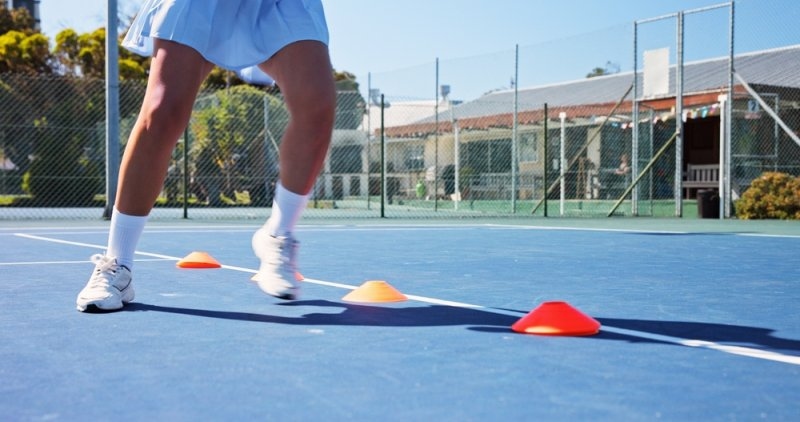
Replicating court footwork patterns around physical cones sharpens direction changes and dynamic body balance.
Integrating structured tennis movement drills accelerates muscle memory and establishes split-second reaction habits.
Build dynamic reaction speed and split-step timing, and set up four cones in a square near the baseline. Start in the center, perform a split step, and sprint explosively to touch each cone before returning to the middle recovery position.
Master lateral baseline movement and quick changes of direction. Place two cones five feet apart along the baseline. Move in a continuous figure-eight pattern using lateral shuffles and crossover recovery steps while keeping your shoulders facing forward.
Enhance forward acceleration and backward recovery. Sprint forward from the baseline to an imaginary short ball, plant your outside foot to swing, and immediately backpedal in balance to your starting position.
Identifying movement errors early prevents long-term bad habits and reduces the risk of lower body injuries.
Resting on your heels slows down reaction time significantly. Always keep your weight distributed on the balls of your feet, staying active with light adjustment bounces between hits.
Taking large steps close to the ball leads to improper spacing and jammed swing paths. Use long strides to cover distance, followed by small adjustment steps to fine-tune your hitting distance.
Must Try: Best Tennis Shoes for Hard Courts, Clay Courts, and Grass Courts
Elevating your movement capabilities transforms your entire performance on court, granting you extra time to execute clean, powerful strokes. Throughout this guide, we defined core footwork concepts, detailed foundational movement principles, and compared essential technical setups like the crossover step and lateral shuffle.
We also highlighted off-court conditioning exercises, outlined step-by-step agility routines, and identified common footwork mistakes to avoid. Consistently integrating these movement habits into your weekly practice sessions builds lower body endurance and explosive reaction timing. As your movement becomes second nature, you will command the court with total confidence and control.
Ready to take complete charge of your athletic performance with top-tier gear, court insights, and expert training guides? Explore our full collection of equipment reviews, performance breakdown guides, and coaching tips today to boost your game every single time you step onto the court!
Take full command of your athletic performance today by utilizing top-tier training guides and expert sports reviews!
Hard courts require sharp deceleration, firm foot plants, and quick direction shifts due to high surface traction. Clay courts demand controlled sliding mechanics, where players slide into shots on their outside foot while keeping balance. Grass courts require shorter adjustment steps and a lower center of gravity due to fast, low ball bounces.
Incorporating two to three dedicated footwork sessions per week yields optimal improvements in speed and agility. Integrating short ten-minute agility ladders or movement routines into your regular pre-practice warmups maintains muscle memory, joint stability, and sharp foot speed without overtraining lower body muscles.
Tennis-specific footwear features rigid lateral stability supports, reinforced toe caps, and specialized outsole traction patterns designed for multidirectional movement. Running shoes lack necessary lateral support, increasing the risk of ankle rolls during sudden stops and side-to-side direction changes on court.
Exhaling during movement direction changes and ball impact relaxes upper body tension, allowing smooth energy transfer from the legs through the torso. Synchronizing steady breathing patterns with split steps and adjustment footwork reduces fatigue and helps maintain focus during intense rallies.
A strong core acts as a stabilizer between lower body movement and upper body swing mechanics. Maintaining core engagement during high-speed sprints and lateral changes of direction prevents excessive body leaning, enabling smooth recovery steps and balanced strike execution on the run.


 What are the Tennis Rules Every Beginner Should Know?
  Who are the Greatest Tennis Grand Slam Winners So Far?
  Best Tennis Shoes for Hard Courts, Clay Courts, and Grass Courts
  Why Players Change Rackets and How It Impacts Performance?
  What is a Flat Serve in Tennis? Simple Guide for Players
  Tennis Grips 101: How Each Grip Type Impacts Your Game
  AI Coaching: Revolutionizing Tennis Training in 2025