
Close

Losing the ball off your foot during a tight fourth-quarter possession feels heartbreaking when your team needs a clean shot. Practicing the right Basketball Dribbling Drills turns nervous ball handling into effortless court command. According to youth and elite player development guidelines from USA Basketball and the National Basketball Coaches Association, guards who dedicate just twenty minutes daily to structured ball control cut unforced turnovers by nearly 35% over a single season. Building sharp fingertip touch lets you read the defense with your head up instead of staring at the floor.
Understanding how to progress from basic rhythm bounces to game-speed moves removes frustration from solo gym sessions. It empowers you to protect the basketball under heavy full-court pressure.
In this comprehensive training guide, we share the best basketball dribbling drills and dribbling drills to improve basketball skills, break down basketball dribbling drills for beginners and stationary basketball dribbling drills, explore basketball ball-handling drills, basketball dribbling exercises for players, basketball dribbling drills for speed and control, basketball crossover dribbling drills, and advanced basketball dribbling drills, and explain how to improve dribbling skills in basketball.
Mastering stationary basketball dribbling drills lays the essential foundation before you ever sprint down the hardwood.
These basketball dribbling drills for beginners teach your fingertips to absorb and push the ball cleanly without looking down. Keep your knees bent, your chest proud, and your off arm raised to shield against defenders.
Stand in an athletic squat and bounce the ball forcefully below knee height using only your fingertips. Perform thirty rapid pounds with your right hand, then switch immediately to your left hand to build weak hand confidence.
Use one hand to push the ball diagonally across your body from right to left in a sharp V shape. Focusing on wrist snap during these basketball ball-handling drills improves lateral control when navigating tight traffic.
Spread your feet wider than shoulder width and dribble the ball smoothly in a continuous figure-eight pattern through both legs. Keeping the ball low to the floor trains quick hand transitions and sharp peripheral awareness.
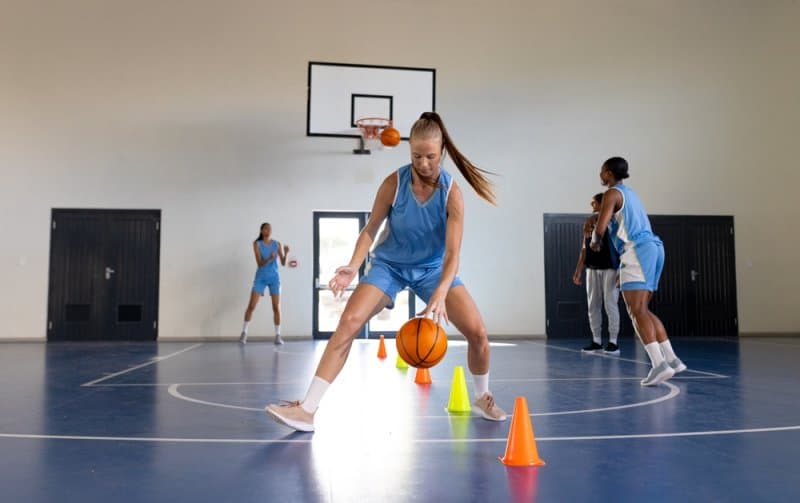
Practicing basketball crossover dribbling drills alongside basketball dribbling drills for speed and control teaches you how to shift defender momentum instantly.
Stay low in your stance and snap the ball sharply from your right hand to your left below knee height. A tight, low trajectory keeps the ball safe from reaching hands while setting up explosive first steps.
Step forward with your left foot and bounce the ball crisply through your legs to your left hand, then reset and repeat. Combining rapid rhythm changes with clean footwork makes these basketball dribbling exercises for players highly effective in one-on-one situations.
Wrap the ball firmly around your lower back from your dominant hand to your off hand while keeping your shoulders square. Using this move when trapped along the sideline creates immediate space to reset the offense.
Adding movement and dual ball challenges turns advanced basketball dribbling drills into realistic game preparation.
Dribble two basketballs simultaneously at waist height, then switch to an alternating piston rhythm for forty-five seconds. Training both hands together forces your brain to build ambidextrous coordination quickly.
Sprint diagonally from the baseline to the free-throw line, execute two hard retreat dribbles backward, and cross over toward the opposite sideline. This drill simulates breaking a full-court press while maintaining composure under fatigue.
Dribble a basketball continuously with your right hand while tossing and catching a tennis ball with your left hand. Splitting your visual focus trains you to scan teammates and open cutting lanes while maintaining a live dribble.
Set three cones five feet apart along the perimeter and attack each cone using an inside-out hesitation move before exploding toward the rim. Practicing game-speed footwork alongside tight ball control turns practice repetitions into reliable scoring moves.
Must Try: How to Improve Tennis Footwork with Proven Movement Drills?
Choosing the right dribbling drills to improve basketball skills depends on your current experience level and game role.
| Drill Category | Primary Skill Focus | Recommended Weekly Frequency | Best Training Environment |
| Stationary Foundation Drills | Fingertip touch, posture, and weak hand strength | Four to five sessions of fifteen minutes | Driveway, garage, or half court baseline |
| Crossover and Combo Drills | Direction changes, low bounce height, and footwork | Three to four sessions of twenty minutes | Full court perimeter with training cones |
| Two Ball and Distraction Drills | Ambidextrous control and eyes-up court vision | Three sessions of fifteen minutes | Indoor hardwood court with partner or timer |
Applying smart training habits accelerates how to improve dribbling skills in basketball every single week.
Transforming shaky ball handling into confident playmaking starts with consistent, focused effort on the court every week. Throughout this training guide, we walked through ten structured routines spanning stationary fingertip foundations, rapid crossover combinations, and game-speed two-ball challenges. We also compared drill categories by skill focus and outlined four practical habits—including eyes-up posture and weak-hand prioritization—to help you break through skill plateaus faster.
Great ball handlers are built through thousands of purposeful repetitions rather than natural luck alone. When you embrace mistakes during practice, your confidence soars when the game clock winds down. To explore expert equipment reviews, discover proven athletic training guides, and elevate your performance across every sport today, visit our dedicated sports review hub for trusted insights that sharpen your game.
Official regulation sizing ensures players develop accurate fingertip feel and bounce timing that transfers directly to competition. Women and youth players aged twelve and older should train with a size six basketball measuring twenty-eight point five inches, while men and boys aged fifteen and older should use an official size seven ball measuring twenty-nine point five inches.
A properly inflated basketball should hold between seven point five and eight point five pounds per square inch of air pressure. When dropped from a height of six feet onto a standard hardwood floor, a correctly inflated ball bounces smoothly back up to roughly four feet, providing consistent rebound speed for rapid dribbling drills.
Yes, stationary ball handling routines require only a flat six-by-six-foot patch of smooth concrete, wood, or rubber flooring and zero basket access. Practicing pound dribbles, figure eights, and rapid crossovers inside a garage or basement builds elite hand speed and muscle memory year-round regardless of outdoor weather.
Most dedicated players notice measurable improvements in weak hand speed, bounce height, and coordination within three to four weeks of consistent daily practice. Spending just fifteen focused minutes each day performing pound dribbles and crossovers exclusively with your nondominant hand rewires neural pathways faster than occasional long sessions.
Outdoor concrete and asphalt courts quickly wear down soft indoor leather covers, making durable composite leather or heavy-duty rubber basketballs ideal for driveway training. Choosing an indoor outdoor composite ball preserves deep pebble grip channels so your fingertips maintain reliable traction during intense crossover and retreat drills.


 How to Choose Basketball Shoes for Peak Performance?
 Who are the Top 10 Richest NBA Players of all Time?
 Why Sports Nutrition for Basketball Players is Essential?
 NBA 2025 Season: Teams, Players & Championship Predictions
 Beyond the Score: Key Metrics for Elite Basketball Analysis
 Top 10 American NBA Stars to Watch in 2024: A Closer Look
 How Teamwork Drives Basketball Success: Insights, Strategies